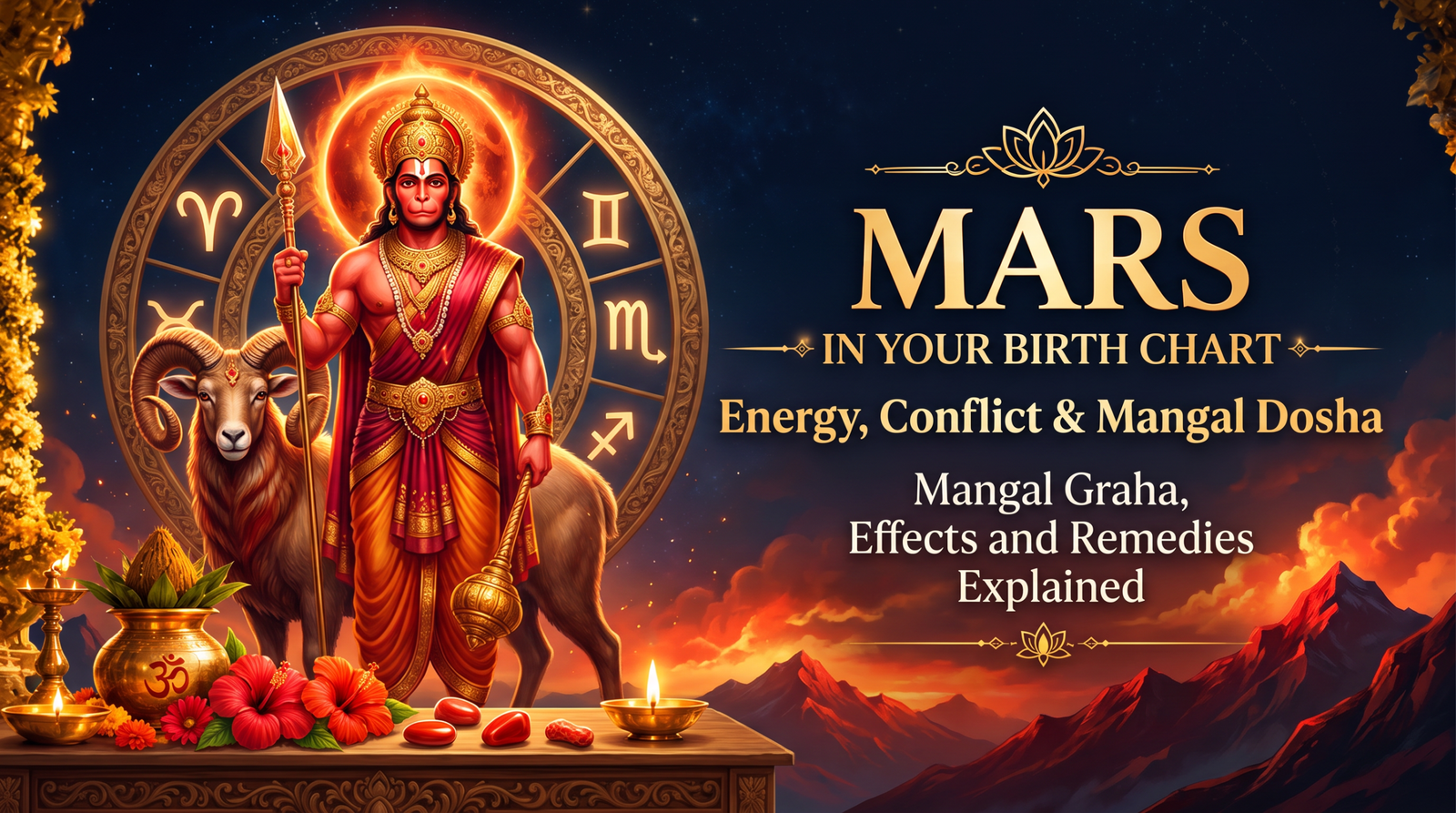
In Vedic Astrology, Mars is known as Mangal or Kuja. It represents energy, courage, determination, initiative, physical strength, competition and the ability to take action. Mars is traditionally associated with how a person approaches challenges, handles pressure and expresses assertiveness.
Mars is also an important planet in marriage compatibility analysis because certain placements are considered when assessing Mangal Dosha, commonly known as Manglik Dosha. However, its presence should never be interpreted in isolation or treated as an automatic indication of relationship difficulties.
In this guide, we explore the meaning of Mars in Vedic Astrology, its placement in all twelve houses, its special planetary aspects and its role in traditional Kundli interpretation.
1. What Does Mars Represent in Vedic Astrology?
Mars is called Mangal or Kuja in Vedic Astrology. Its symbolism is connected with action, courage, ambition, strength and the ability to overcome obstacles.
Its traditional significations include:
- Energy and action: Initiative, drive, determination and the willingness to act.
- Courage: Confidence, bravery and the ability to face challenges.
- Competition: Sports, contests, ambition and the desire to achieve goals.
- Physical strength: Vitality, muscular activity and physical effort in traditional symbolism.
- Land and property: Real estate, land, construction and related matters.
- Technical skills: Engineering, machinery, tools, mechanics and practical problem-solving.
- Conflict and assertiveness: Anger, confrontation, boundaries and the expression of strong opinions.
These associations are symbolic concepts within traditional astrology. They should not be used to assume that someone is naturally aggressive, violent or confrontational simply because Mars occupies a particular house or sign.
2. Mars as a Natural Malefic Planet
In classical Vedic Astrology, Mars is generally classified as a natural malefic planet. This classification relates to its traditional association with heat, force, competition, conflict and intense action.
However, natural malefic status does not mean that Mars always produces negative results. Its energy can be associated with courage, discipline, leadership, initiative and the determination needed to overcome difficult situations.
Its functional role also depends on the Ascendant. Mars rules different houses for different Lagnas, so its overall interpretation can vary significantly between horoscopes.
3. Mars’s Own, Exalted and Debilitated Signs
Planetary dignity is an important factor in traditional Vedic Astrology. Mars has the following sign relationships:
- Own signs: Aries (Mesha) and Scorpio (Vrischika).
- Exaltation sign: Capricorn (Makara).
- Debilitation sign: Cancer (Karka).
Mars is traditionally considered strong in its own signs, Aries and Scorpio. It is exalted in Capricorn, where its energy is associated with disciplined effort, structure and practical action. Cancer is its debilitation sign in classical sign dignity.
These conditions do not independently determine whether a person’s life will be successful or difficult. House ownership, house placement, aspects, conjunctions and other chart factors must also be considered.
4. Mars in the 12 Houses of a Birth Chart
The house occupied by Mars indicates the area of life in which its traditional themes of action, energy, courage and assertiveness may become relevant. The following are general interpretations, not fixed predictions.
Mars in the 1st House
Mars in the Ascendant may be associated with initiative, confidence, independence and a direct approach to challenges. Depending on the rest of the horoscope, this placement may also invite attention to patience and the management of impulsive reactions.
Mars in the 2nd House
The second house represents family, speech, accumulated wealth and personal values. Mars here may be examined in relation to direct communication, family responsibilities, financial decisions and the way disagreements are expressed.
Mars in the 3rd House
The third house relates to courage, communication, siblings, skills and personal effort. Mars may symbolically support initiative, competitive ability and practical determination. The condition of the third house and its lord remains important.
Mars in the 4th House
The fourth house represents home, mother, property, vehicles and emotional foundations. Mars here may bring attention to property matters, domestic responsibilities and the need to manage tension constructively within the home environment.
Mars in the 5th House
The fifth house relates to education, creativity, intelligence, romance and children. Mars may be associated with competitive thinking, energetic creativity and a strong desire to pursue personal interests. Other fifth-house factors are essential when examining education, romance or children.
Mars in the 6th House
The sixth house represents competition, service, debts, disputes and daily responsibilities. Mars here may be interpreted through determination, the ability to face challenges and a competitive approach to work. Its condition and relationship with the sixth house lord should be assessed.
Mars in the 7th House
The seventh house relates to marriage, committed partnerships and business relationships. Mars here may highlight assertiveness, strong preferences and the importance of managing disagreements respectfully. This placement is also one of the positions examined in many traditional Mangal Dosha assessments.
Mars in the 8th House
The eighth house is associated with transformation, shared resources, inheritance, research and sudden changes. Mars here may be examined in connection with intense experiences, shared financial responsibilities and the need for thoughtful decision-making.
Mars in the 9th House
The ninth house represents higher learning, dharma, teachers, philosophy and long-distance journeys. Mars may be associated with strong convictions, independent thinking and an active approach to pursuing beliefs or educational goals.
Mars in the 10th House
The tenth house relates to career, public reputation, responsibilities and professional achievement. Mars may be associated with leadership, initiative, technical work, engineering, operations and competitive professions. Career analysis also requires the tenth house lord and other professional indicators.
Mars in the 11th House
The eleventh house represents income, gains, networks, friendships and aspirations. Mars here may be interpreted through ambition, goal-oriented action, competition and active participation in groups or professional networks.
Mars in the 12th House
The twelfth house relates to expenditure, foreign connections, isolation, rest, retreats and private activities. Mars here may be examined in connection with expenditure, work behind the scenes, foreign environments and the management of personal energy.
To understand any Mars placement accurately, astrologers consider the Ascendant, the sign occupied by Mars, its house ownership, planetary aspects and the overall chart. For more information, explore our guide to the 12 Houses in Vedic Astrology.
5. Mars’s Special Planetary Aspects
In the traditional Parashari system, Mars has three important aspects:
- 4th aspect: Mars aspects the fourth sign or house counted from its position.
- 7th aspect: Mars aspects the seventh sign or house from its position.
- 8th aspect: Mars aspects the eighth sign or house from its position.
The seventh aspect is shared by all seven classical planets in this system. Mars’s additional fourth and eighth aspects are distinctive features of its traditional aspect pattern.
These aspects are considered when interpreting the houses and planets influenced by Mars. Their meaning depends on Mars’s dignity, functional role, conjunctions and the condition of the houses involved.
6. What Is Mangal Dosha?
Mangal Dosha, also known as Manglik Dosha or Kuja Dosha, is a traditional concept in Vedic Astrology used during marriage compatibility analysis.
In commonly followed assessment methods, Mars occupying certain houses from the Ascendant is considered a Mangal Dosha indication. These houses commonly include:
- 1st house
- 2nd house
- 4th house
- 7th house
- 8th house
- 12th house
Some traditions use different sets of houses or examine the placement from additional reference points, such as the Moon or Venus. Therefore, the assessment method should be clearly understood before drawing conclusions.
Mangal Dosha is traditionally associated with themes such as assertiveness, intensity and adjustment within marriage. It is not a scientifically established measure of relationship compatibility and does not prove that a person will experience marital conflict or separation.
7. Why Should Mangal Dosha Not Be Judged by Mars Alone?
Finding Mars in one of the commonly listed houses is only the beginning of a traditional Mangal Dosha assessment. A detailed analysis may consider:
- The sign and dignity of Mars.
- The house occupied by Mars and the Ascendant lord.
- Benefic and malefic planetary aspects.
- Conjunctions involving Mars.
- The condition of the seventh house and its lord.
- Venus and Jupiter as additional relationship indicators.
- The Navamsa Chart (D9).
- Relevant planetary periods and the wider horoscope.
Different classical and regional traditions also use different cancellation or modification rules. A placement should not be declared harmless or harmful based on one simplified rule.
For a detailed explanation of the concept, read our upcoming guide on What Is Manglik Dosha? Understanding Its Meaning and Cancellation.
8. Mars and Marriage Compatibility
Mars is one of several factors considered in traditional marriage compatibility analysis. Its placement may be examined to understand how assertiveness, personal boundaries, energy and conflict-related themes are symbolically represented in a horoscope.
A balanced compatibility assessment may include:
- The seventh house and its ruling planet in both charts.
- Mars’s placement, dignity and aspects.
- Venus and Jupiter as relationship-related significators.
- The Navamsa Chart (D9).
- Moon sign and Nakshatra compatibility, where relevant.
- Relevant Mahadasha and Antardasha periods.
- The overall connections between the two birth charts.
Marriage compatibility should also consider communication, shared values, mutual respect, emotional maturity and the practical circumstances of both individuals. No single planetary placement can determine whether a relationship will succeed.
Explore our guides to the 7th House in Vedic Astrology and Venus in Vedic Astrology for more information.
9. Mars Mahadasha in Vedic Astrology
In the Vimshottari Dasha system, Mars Mahadasha lasts for 7 years.
Its traditional themes may include action, ambition, competition, courage, property matters, technical activities and the need to manage energy constructively.
To interpret Mars Mahadasha, astrologers may examine:
- Mars’s house placement and sign dignity.
- The houses ruled by Mars for the person’s Ascendant.
- Conjunctions and planetary aspects.
- The Antardasha operating within Mars Mahadasha.
- Relevant transits and divisional chart indications.
The same Mars Mahadasha can be interpreted differently in different horoscopes. It should not automatically be described as a difficult or favourable period.
Learn more about planetary periods in our guide to Mahadasha in Vedic Astrology.
10. How Do Astrologers Assess Mars’s Strength?
A detailed Mars interpretation considers several factors together:
- Sign dignity: Whether Mars occupies its own, exalted, debilitated or another sign.
- House placement: The life area in which Mars is positioned.
- House ownership: Which houses Mars rules for the particular Ascendant.
- Planetary aspects: The planets influencing Mars and the houses it aspects.
- Conjunctions: Other planets sharing the same sign or house.
- Combustion and retrogression: These conditions may be considered within the chosen astrological tradition.
- Divisional charts: Relevant charts, including the Navamsa, depending on the question being analysed.
- Dasha and transit: Timing factors considered alongside the birth chart.
No single factor should be used as a complete measure of Mars’s influence. The overall horoscope provides the necessary context.
11. Common Misconceptions About Mars
Does Mars Always Cause Anger?
No. Mars symbolises energy, action and assertiveness in traditional astrology. Its expression depends on the complete chart and cannot be reduced to a single personality trait.
Does Mangal Dosha Guarantee Marriage Problems?
No. Mangal Dosha is a traditional astrological classification, not a proven predictor of relationship outcomes. It should not be used to judge a person’s suitability for marriage.
Is Exalted Mars Always Positive?
No. Exaltation is a sign dignity condition. House ownership, placement, aspects and the wider horoscope must also be considered.
Does Mars in the Seventh House Mean Divorce?
No. Mars in the seventh house does not independently establish divorce or relationship failure. Marriage analysis requires several chart factors and real-life context.
Is Mars Always Malefic?
Mars is generally classified as a natural malefic, but it can also represent courage, initiative, discipline and the ability to face challenges. Its functional role varies by Ascendant.
12. Why Is a Complete Kundli Analysis Important?
Two people may have Mars in the same house but experience very different circumstances. Their Ascendants, planetary dignity, house ownership, aspects, conjunctions and Dasha periods may be entirely different.
For this reason, an astrologer should interpret Mars as part of the complete birth chart rather than making conclusions from one placement alone.
A personalised Kundli interpretation can help explain Mars’s traditional significance, its relationship with other planets and the role it plays in specific areas of a horoscope.
Frequently Asked Questions
What is Mars called in Vedic Astrology?
Mars is known as Mangal or Kuja in Vedic Astrology. It is traditionally associated with energy, courage, action, competition and determination.
Which zodiac signs are ruled by Mars?
Mars rules Aries (Mesha) and Scorpio (Vrischika) in traditional Vedic Astrology.
In which sign is Mars exalted?
Mars is traditionally exalted in Capricorn (Makara).
In which sign is Mars debilitated?
Mars is traditionally debilitated in Cancer (Karka).
How long does Mars Mahadasha last?
Mars Mahadasha lasts for 7 years in the Vimshottari Dasha system.
Which houses are commonly considered for Mangal Dosha?
Many commonly followed traditions examine Mars in the 1st, 2nd, 4th, 7th, 8th and 12th houses. Some traditions use different assessment methods and reference points.
Can Mangal Dosha be cancelled?
Different Vedic Astrology traditions recognise various conditions that may modify or reduce the traditional interpretation of Mangal Dosha. These conditions should be assessed within the complete horoscope rather than through a single rule.
Conclusion
Mars is an important planet in Vedic Astrology, traditionally representing courage, energy, determination, competition and action. Its placement in the birth chart can provide insight into the areas where these themes may become relevant.
It is also an important consideration in traditional Mangal Dosha and marriage compatibility analysis. However, Mars should never be interpreted alone or used to make frightening or absolute predictions about someone’s future.
A balanced Kundli reading considers Mars alongside the Ascendant, house lords, other planets, divisional charts and planetary periods to develop a more complete interpretation.
Explore Your Birth Chart
Would you like to understand Mars’s placement or explore Mangal Dosha in your Kundli? A personalised Vedic Astrology consultation can help you understand the traditional chart factors involved.
Visit Bikram Astro Insights to explore available astrology services.
Disclaimer
Vedic Astrology is a traditional belief-based system and is not scientifically established as a method of predicting individual outcomes. This article is intended for educational and informational purposes only. It should not be considered a substitute for professional medical, legal, financial or mental-health advice. Interpretations may vary between astrological traditions and practitioners.